new to the gluten free journey?



| Key Point | Summary |
| What Vitamin B3 does | Supports NAD and NADP production, energy metabolism, DNA repair, nervous system function, skin health, and cellular repair. |
| Main forms | Nicotinic acid, niacinamide, nicotinamide riboside, NMN, and related NAD precursors. |
| Deficiency symptoms | Fatigue, poor appetite, skin rash, mouth inflammation, digestive symptoms, mood changes, memory problems, and severe pellagra. |
| Who is at risk | People with malabsorption, celiac disease, gluten sensitivity, alcohol use, poor diet, bariatric surgery, carcinoid syndrome, inflammatory bowel disease, and some medication exposures. |
| Best tests | Urinary niacin metabolites, erythrocyte NAD, NAD/NADP markers, tryptophan status, and intracellular nutritional analysis (INA). |
| Food sources | Tuna, salmon, chicken, turkey, beef, liver, mushrooms, avocado, sunflower seeds, pumpkin seeds, and peanuts if tolerated. |
| Safe dose | Adult RDA is 16 mg NE for men and 14 mg NE for women. The adult UL for supplemental niacin is 35 mg/day, mainly due to flushing risk. Higher doses are used in human studies under clinical monitoring. |
| Caution | High-dose nicotinic acid can cause flushing, itching, liver enzyme elevations, glucose changes, uric acid elevation, and gastrointestinal symptoms. |
Vitamin B3 (niacin) deficiency can cause an array of symptoms that mimic other medical conditions, so before you accept another medication or diagnosis, ask a basic question: Could your problem(s) be a vitamin B3 deficiency?
Vitamin B3 is an essential water soluble vitamin responsible for helping the body build NAD, one of the most important molecules in human health. Vitamin B3 represents a family of related nutrients that includes nicotinic acid, commonly called niacin, niacinamide, also called nicotinamide, nicotinamide riboside (NR), nicotinamide mononucleotide (NMN), and related compounds that help build NAD. It is one of the most important molecules in human metabolism.
When Vitamin B3 is low, the body can struggle with energy production, skin repair, brain function, digestion, detoxification, and cellular defense. Severe deficiency causes pellagra, classically associated with dermatitis, diarrhea, dementia, and, if untreated, death.
| Category | Key Details |
| Nutrient name | Vitamin B3 |
| Nutrient type | Water-soluble B vitamin |
| Main body functions | NAD/NADP production, energy metabolism, mitochondrial function, DNA repair, skin health, nervous system support, cellular signaling |
| Deficiency symptoms | Fatigue, poor appetite, dermatitis, diarrhea, mouth inflammation, mood changes, memory problems, neuropathy-like symptoms, pellagra |
| Common depletion causes | Poor diet, malabsorption, alcohol use, chronic inflammation, digestive disease, gluten-related intestinal damage, bariatric surgery, carcinoid syndrome |
| Medications linked to deficiency risk | Isoniazid, some chemotherapy drugs, long-term alcohol exposure, and drugs that impair appetite, digestion, absorption, or nutrient status |
| Best tests | Urinary N1-methylnicotinamide, 2-pyridone metabolites, erythrocyte NAD, NAD/NADP markers, tryptophan, intracellular nutrient analysis |
| Grain-free food sources | Tuna, salmon, chicken, turkey, beef, liver, mushrooms, avocado, sunflower seeds, pumpkin seeds |
| Typical supplemental forms | Nicotinic acid, niacinamide, NR, NMN, inositol hexanicotinate, NAD precursors |
| Human research uses | Pellagra correction, lipid metabolism, skin cancer risk reduction in high-risk patients, NAD elevation, metabolic research, vascular aging research |
| Safe dose range | RDA: 14 to 16 mg NE/day for adults. UL: 35 mg/day from supplements for adults. Clinical trials use higher doses by form and goal. |
| Signs of too much | Flushing, itching, nausea, liver stress, glucose changes, uric acid elevation, easy bruising with high-dose nicotinamide |
| Dr. Osborne Gluten Free Supplements with Vitamin B3 | Ultra B3, B-Complete, Graceful Aging, and Ultra Nutrients may be supportive depending on testing and health goals. Ultra B3 contains nicotinic acid, B Complete contains niacinamide, Graceful Aging contains nicotinamide riboside (NR), and Ultra Nutrients contains both niacin and niacinamide. |
Vitamin B3 is a water-soluble B vitamin used to build two major coenzymes:
These molecules help enzymes transfer electrons, produce energy, regulate oxidative stress, repair DNA, and support cellular communication. All tissues convert absorbed niacin into NAD, which can then be converted into NADP.
This is where many people get confused.
| Form | Also Called | Primary Use | Flush? | Key Distinction |
| Nicotinic acid | Niacin | NAD support, lipid metabolism | Yes, commonly | Best known for raising HDL and lowering triglycerides at high doses, but can flush and stress the liver in high doses |
| Niacinamide | Nicotinamide | NAD support, skin, DNA repair | Usually no | Does not have the same lipid effects as nicotinic acid |
| Nicotinamide riboside | NR | NAD precursor | No typical niacin flush | Human trials show it raises NAD-related metabolites |
| Nicotinamide mononucleotide | NMN | NAD precursor | No typical niacin flush | Human trials show it can raise blood NAD and may influence insulin sensitivity in specific populations |
| Inositol hexanicotinate | “No-flush niacin” | Often marketed for niacin support | Usually less flush | May not deliver the same lipid effects as nicotinic acid |
Key Takeaway: “Vitamin B3” is the family name. Nicotinic acid and niacinamide are not identical. NR and NMN are NAD-focused precursors. The right form depends on the goal.
The history of Vitamin B3 is tied to pellagra, a devastating deficiency disease once common in populations relying heavily on corn-based diets.
Joseph Goldberger helped prove pellagra was nutritional rather than infectious. In 1937, researchers identified niacin, or nicotinic acid, as the factor that could prevent pellagra.
This discovery changed medicine because it showed that a disease affecting the skin, gut, and brain could be caused by a missing nutrient.
Vitamin B3 helps make NAD and NADH, which are required for converting food into cellular energy. NAD participates in oxidation-reduction reactions throughout metabolism.
When B3 status is poor, energy production can suffer. Clinically, this may show up as fatigue, low stamina, poor exercise tolerance, and “I just don’t recover like I used to.”
Mitochondria need NAD to help generate ATP. ATP is the energy currency of the cell.
In my clinical experience, when people lack adequate B3, they chase energy drinks, coffee, or other stimulants to help overcome their fatigue.
NAD is consumed by enzymes involved in DNA repair, including PARP enzymes. Niacin deficiency can reduce NAD pools and affect NAD-consuming enzymes involved in genomic stability.
Severe B3 deficiency causes dermatitis. Nicotinamide has also been studied in human trials for nonmelanoma skin cancer prevention in high-risk patients. In a phase 3 randomized trial, 500 mg of nicotinamide twice daily reduced the rate of new nonmelanoma skin cancers in high-risk patients during the intervention period.
Pellagra can cause mood changes, confusion, cognitive decline, and dementia-like symptoms. This is one reason nutrient deficiency should always be part of the conversation when patients have unexplained neurological or psychiatric symptoms.
NADP helps generate NADPH, which supports antioxidant recycling and detoxification pathways. This does not mean B3 is a “detox cure.” It means the body’s detoxification systems require nutrient-dependent chemistry.
NMN and NR are being studied as NAD precursors in metabolic aging, insulin sensitivity, blood pressure, and mitochondrial function. A human trial in postmenopausal women with prediabetes found that NMN improved muscle insulin sensitivity and insulin signaling.
Classic pellagra is less common in the United States because grain products are fortified. But that does not mean optimal Vitamin B3 status is guaranteed. In my clinic, vitamin B3 inadequacy as measured through INA (intracellular nutrient analysis), is much more common than conventional thoughts.
Deficiency and depletion can occur when intake, absorption, conversion, or demand is disrupted.
Common contributors include:
Key Takeaway: Deficiency is not rare when digestion, absorption, inflammation, alcohol use, medication exposure, and protein status are compromised. If you have the above conditions, talk with your doctor about testing your levels.
| Body System | Possible Deficiency Symptoms |
| Energy/metabolism | Fatigue, weakness, poor stamina, reduced appetite |
| Brain/mood | Irritability, depression-like symptoms, confusion, memory problems |
| Nerves | Burning sensations, neuropathy-like symptoms, poor coordination in severe cases |
| Muscles | Weakness, poor exercise tolerance |
| Skin/hair/nails | Sun-sensitive rash, dermatitis, cracked skin, inflamed skin |
| Immune system | Poor resilience, impaired tissue repair |
| Gut/digestion | Diarrhea, nausea, poor appetite, inflamed mouth or tongue |
| Cardiovascular | Low B3 status may impair metabolic resilience, while high-dose nicotinic acid affects lipids |
| Hormones | Indirect effects through energy metabolism and stress chemistry |
| Blood/oxygen transport | Not a primary anemia nutrient, but low intake often occurs with broader B-vitamin deficiency |
Severe deficiency causes pellagra, known for the “three Ds” of dermatitis, diarrhea, and dementia, with death as the fourth D if untreated.
Higher-risk groups include:
Carcinoid syndrome can contribute to niacin deficiency because tryptophan is diverted toward serotonin production, reducing tryptophan available for niacin synthesis.

| Medication or Drug Class | How It May Affect Vitamin B3 | Possible Consequences |
| Isoniazid | Can interfere with niacin metabolism and has been linked to pellagra | Dermatitis, diarrhea, neurological symptoms |
| Chemotherapy drugs such as 5-FU | Case literature links chemotherapy exposure with pellagra-like niacin deficiency in vulnerable patients | Skin, gut, neurological symptoms |
| Long-term alcohol exposure | Impairs intake, absorption, liver metabolism, and overall B-vitamin status | Pellagra risk, fatigue, neurological symptoms |
| Appetite-suppressing drugs | May reduce food intake and protein intake | Lower B vitamin and tryptophan intake |
| GLP-1 medications | May reduce total nutrient intake through appetite suppression and GI effects | Possible secondary nutrient depletion. |
| Chronic antibiotics | May disrupt gut ecology and appetite, though direct B3 depletion is less established | Broader B-vitamin imbalance risk |
| Proton pump inhibitors/H2 blockers | Not a primary niacin-depletion class, but known to impair digestion and nutrient release from food | Broader nutrient malabsorption risk |
Key Take Away: Prescription drug use is at an all time high. If you are using medications, it is important to discuss drug induced nutritional deficiency risks with your doctor so that your nutritional status can be monitored to prevent deficiency.
| Surgery | Why Risk May Increase |
| Gastric bypass | Reduced intake, altered digestion, malabsorption |
| Sleeve gastrectomy | Reduced food intake and possible reduced nutrient density |
| Bowel resection | Less absorptive surface area |
| Ileal or intestinal surgery | Chronic malabsorption risk |
| Pancreatic surgery | Impaired digestive enzyme output |
| Gallbladder removal | May impair fat handling and digestive tolerance, indirectly lowering diet quality |
Bariatric surgery has been associated with pellagra in case literature, especially when compounded by alcohol intake or poor nutrition.
Key Takeaway: Surgical-induced nutrient depletion is one of the most overlooked causes of chronic symptoms.
Niacin deficiency causes pellagra. Correcting deficiency resolves the disease when addressed early. Pellagra is the classic proof that skin, gut, and brain symptoms can originate from nutrient deficiency.
Nicotinic acid has long been used in high doses to modify cardiovascular disease risk. Niacin therapy has been shown to reduce LDL (bad cholesterol), triglycerides, Lp(a), while simultaneously increasing HDL (good cholesterol).
Some niacin formulations are FDA approved for the treatment of dyslipidemia. The drawback to niacin treatment can be the side effects. At higher doses, flushing, and GI tract symptoms are not uncommon.
In the ONTRAC phase 3 randomized trial, high-risk patients taking nicotinamide 500 mg twice daily had fewer new nonmelanoma skin cancers during the treatment period compared with placebo.
Practical takeaway: the niacinamide form of vitamin B3 has human research for skin DNA repair and skin cancer prevention in high-risk groups. It is not the same as nicotinic acid and does not typically cause the classic niacin flush.
Human trials show that NR can raise NAD-related metabolites. In older adults with mild cognitive impairment, 1 gram per day for 10 weeks was reported as safe and increased blood NAD-related measures, though cognition did not significantly improve in that study.
A 2018 randomized crossover trial found chronic NR supplementation was well tolerated and increased NAD metabolism in healthy middle-aged and older adults.
NR has been studied for vascular aging and blood pressure. Early human studies suggest NR can increase NAD metabolism and may improve systolic blood pressure or arterial stiffness in selected groups, but the evidence is still developing.
A 2024 randomized double-blind trial in people with peripheral artery disease reported that NR improved 6-minute walk distance compared with placebo at 6 months.
A randomized, double-blind, placebo-controlled trial reported that oral NMN increased blood NAD concentrations and was safe and well tolerated up to 900 mg per day.
A clinical trial in overweight or obese postmenopausal women with prediabetes found that NMN increased muscle insulin sensitivity and insulin signaling.
Key Takeaway: Nicotinic acid, niacinamide, NR, and NMN have different clinical personalities. Do not treat them as interchangeable.
The adult RDA is 16 mg NE/day for men and 14 mg NE/day for women. Pregnant women need 18 mg NE/day and lactating women need 17 mg NE/day. One niacin equivalent equals 1 mg niacin or 60 mg tryptophan.
The adult tolerable upper intake level for supplemental niacin is 35 mg/day, primarily based on flushing risk from nicotinic acid.
| Goal | Form Used | Dose Range Used in Human Studies | Duration | Notes |
| General maintenance | Niacin equivalents from food or multi | 14 to 16 mg NE/day | Daily | RDA level |
| Deficiency correction | Niacinamide or niacin | Clinically individualized | Until corrected | Severe deficiency needs medical management |
| Skin cancer risk reduction in high-risk patients | Niacinamide | 500 mg twice daily | 12 months in ONTRAC | Human RCT data in high-risk patients |
| NAD support | NR | 250 mg to 1,000 mg/day commonly studied, with higher monitored trials | 6 to 10 weeks or longer | Raises NAD-related metabolites |
| NAD support/metabolic research | NMN | 250 to 900 mg/day in human trials | 10 weeks to 60 days in studies | Human data still developing |
| Lipid metabolism | Nicotinic acid | Often 1,000 to 2,000 mg/day or more in drug-like dosing | Long term | Requires monitoring for liver, glucose, uric acid, flushing |
Dose should always be guided by testing whenever possible, especially with high-dose nicotinic acid, long-term NAD precursor use, liver concerns, gout, diabetes, or multiple medications.
Food-based niacin toxicity does not occur. Most side effect problems come from high-dose supplementation of nicotinic acid.
| Too Much Vitamin B3 May Cause | Why It Happens |
| Flushing, warmth, itching | Prostaglandin-mediated effect, mainly with nicotinic acid |
| Nausea or stomach upset | Dose-related GI irritation |
| Liver enzyme elevation | Higher-dose or sustained-release nicotinic acid risk |
| Increased uric acid | Can aggravate gout risk |
| Blood sugar changes | High-dose nicotinic acid can affect glucose control |
| Liver damage at very high doses of nicotinic acid | NIH notes doses of 3,000 mg/day or more can cause nausea, vomiting, and liver damage |
Testing matters because guessing can lead to underdosing, overdosing, or missing the real root cause.
| Test | What It Measures | Pros | Limitations |
| Urinary N1-methylnicotinamide | Niacin metabolite excretion | Useful marker of niacin status | Collection method needs to be monitored |
| Urinary 2-pyridone | Niacin metabolite | Often used with N1-methylnicotinamide | Requires specialty testing |
| Erythrocyte NAD | Cellular NAD status | More tissue-relevant than simple serum markers | Not always available |
| NAD/NADP | Coenzyme pools | Functional insight | Specialized testing |
| Tryptophan | Precursor for niacin synthesis | Useful when protein status is poor | Not a standalone B3 test |
| Intracellular Nutrient Analysis (INA) | Nutrient status inside cells and how it affects cell function. | Most accurate way to assess a functional B3 deficiency | Requires blood draw |
Dr. Osborne insight: Serum and urine testing can be misleading, as the levels can change rapidly based on recent diet, stress, and other environmental factors. Intracellular measurements are more accurate for measuring long term nutritional status combined with cellular function, because vitamin B3 does its “work” inside the cell.
Do not build your Vitamin B3 strategy around fortified grains. A grain-free plan can supply B3 from nutrient-dense foods.
| Food | Serving Size | Approximate Niacin Content | Notes |
| Yellowfin tuna | 3 oz | High | One of the richest natural sources |
| Chicken breast | 3 oz | High | Lean protein plus tryptophan |
| Turkey | 3 oz | High | Good protein source |
| Salmon | 3 oz | Moderate to high | Also supports omega-3 intake |
| Beef | 3 oz | Moderate | Provides protein and other B vitamins |
| Beef liver | 3 oz | Moderate to high | Also rich in B12, iron, copper |
| Mushrooms | 1 cup | Moderate | Grain-free plant source |
| Avocado | 1 medium | Modest | Also provides potassium and fat |
| Sunflower seeds | 1 oz | Moderate | Seed option |
| Pumpkin seeds | 1 oz | Modest | Mineral-rich |
| Peanuts | 1 oz | Moderate | Legume, not ideal for everyone, avoid if mold-sensitive or intolerant |
USDA FoodData Central is the primary public database for food nutrient content and lists niacin values across foods.

Food is foundational. But food alone may not correct deficiency when:
| Form | Best For | Pros | Cons |
| Nicotinic acid | Lipid metabolism, classic niacin support | Strong historical use, raises NAD | Flush, itching, liver monitoring at high dose |
| Niacinamide | Skin support, NAD support without flush | Usually no flush, human skin trial data | Does not have the same lipid effects as nicotinic acid |
| NR | NAD precursor support | Human studies show NAD metabolite increases | Long-term outcome data still developing |
| NMN | NAD precursor support, metabolic research | Human trials show NAD elevation | Long-term outcome data still being researched |
| Inositol hexanicotinate | Lower-flush niacin support | Better tolerated by some | May not deliver equivalent effects to nicotinic acid |
| NADH/NAD+ products | Direct NAD-related support | Popular in mitochondrial protocols | Oral bioavailability and clinical outcomes vary by product |
For gluten-sensitive patients, the nutrient form matters, but so do the other ingredients in the capsule. Fillers, binders, grain-derived excipients, and hidden contaminants can be a problem for sensitive individuals.
Nutrients do not work in isolation. The body is not a one-nutrient machine. Many nutrients play a synergistic role in helping niacin do its job. The following table illustrates some of this synergism.
| Cofactor | What it does |
| Tryptophan | Can be converted into niacin equivalents |
| Vitamin B6 | Needed for tryptophan metabolism |
| Riboflavin, B2 | Supports redox chemistry and energy metabolism |
| Iron | Involved in tryptophan-to-niacin pathway enzymes |
| Magnesium | Supports ATP and enzyme function |
| Protein | Provides tryptophan and amino acid support |
| Folate and B12 | Support methylation and broader energy metabolism |
| Vitamin C | Supports antioxidant defense and tissue repair |
| Zinc | Supports enzyme systems and immune function |
Simply put, yes.
People with gluten sensitivity and celiac disease may develop nutrient deficiencies because intestinal inflammation can impair absorption. Gluten sensitivity may contribute to Vitamin B3 deficiency through intestinal damage, absorption problems, and interference with tryptophan conversion.
Vitamin B3 becomes especially relevant when a celiac or gluten sensitive patient has:
Dr. Osborne’s take away: Clinically speaking, consuming high calorie, ultra processed, gluten free food substitutes contributes to persistent deficiency in patients trying to recover after years of gluten induced damage. A whole foods diet rich in vitamin B3 containing foods is a great first step. Consider testing for deficiency should you have persistent symptoms that do not resolve after several months of diet. change.

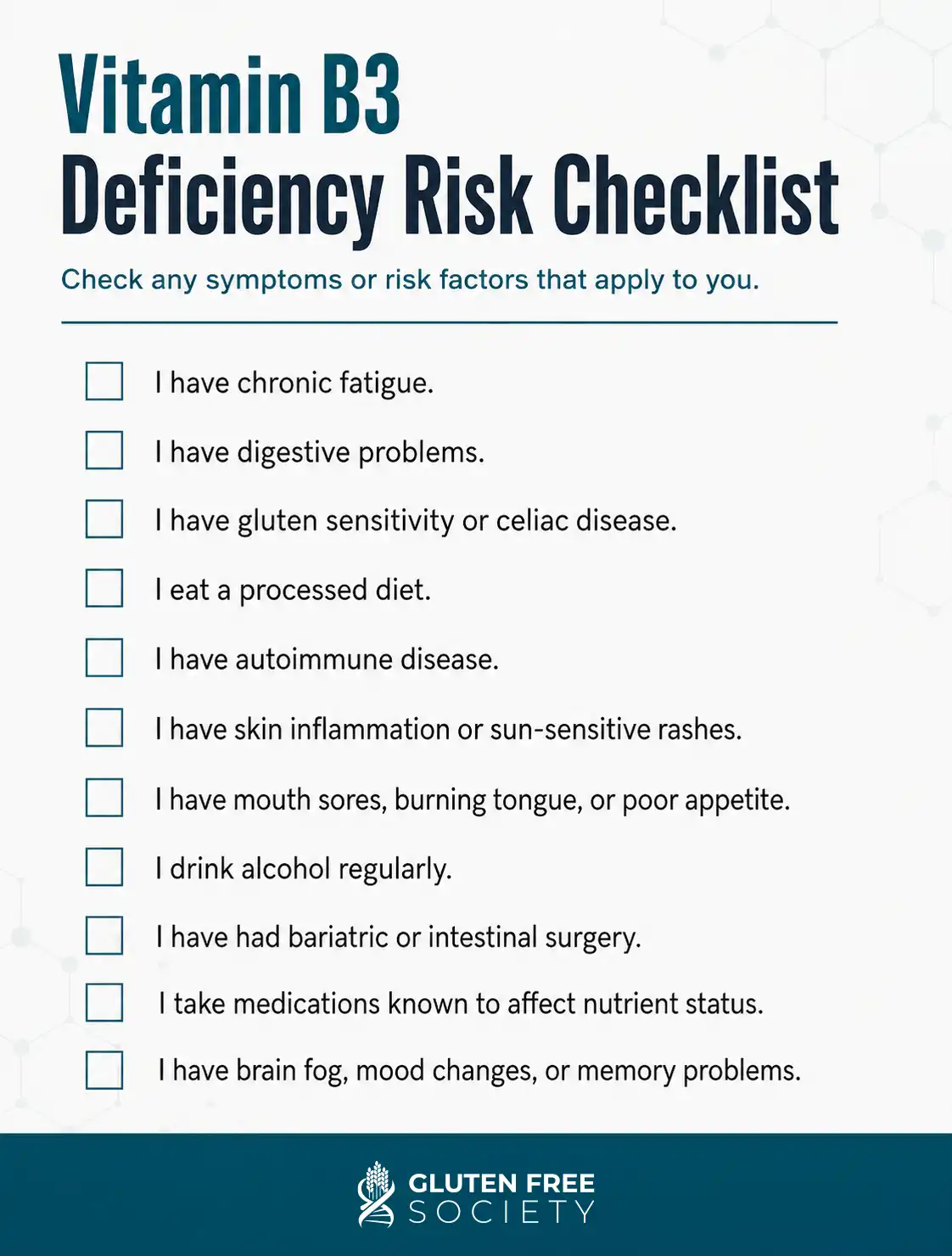
| Mistake | Better Approach |
| Taking high-dose niacin without testing | Test first, especially with liver, gout, diabetes, or medication concerns |
| Confusing niacin with niacinamide | Match the form to the goal |
| Assuming NR and NMN are identical | Both support NAD pathways, but they are distinct compounds |
| Ignoring cofactors | B3 works with protein, B6, B2, iron, magnesium, and other nutrients |
| Using low-quality supplements | Choose grain-free, gluten-free, clean formulas |
| Eating processed gluten-free food | Use nutrient-dense, grain-free foods |
| Ignoring malabsorption | Address gut inflammation and digestion |
| Never retesting | Retest to confirm correction |
Vitamin B3 helps make NAD and NADP, which support energy production, mitochondrial function, DNA repair, skin health, nervous system function, and cellular metabolism.
Low Vitamin B3 may cause fatigue, poor appetite, mouth inflammation, digestive symptoms, skin rash, mood changes, memory problems, and in severe cases pellagra.
Niacin is commonly used to refer to Vitamin B3, but technically Vitamin B3 includes nicotinic acid, niacinamide, NR, NMN, and related NAD precursors.
Nicotinic acid is the classic flushing form of niacin. It is the form most associated with lipid effects at high doses.
Niacinamide, also called nicotinamide, does not usually cause flushing and does not have the same lipid-modifying effect as nicotinic acid. It is often used for NAD support and skin health.
Nicotinamide riboside, or NR, is a Vitamin B3-related NAD precursor. Human studies show it can raise NAD-related metabolites.
NMN, or nicotinamide mononucleotide, is another NAD precursor. Human trials show NMN can raise blood NAD and has been studied for metabolic effects.
Urinary N1-methylnicotinamide and 2-pyridone metabolites are useful markers. Erythrocyte NAD can also provide insight.
Yes. Gluten sensitivity and celiac disease may contribute to low Vitamin B3 by impairing digestion, absorption, and nutrient status. Gluten Free Society specifically discusses gluten-related mechanisms for B3 deficiency.
Tuna, chicken, turkey, salmon, beef, liver, mushrooms, seeds, avocado, and peanuts are grain-free sources. USDA FoodData Central provides food niacin values.
The adult RDA is 16 mg NE/day for men and 14 mg NE/day for women. Higher doses should be guided by form, goal, testing, and safety monitoring.
Yes. High-dose nicotinic acid can cause flushing, itching, liver stress, blood sugar changes, and uric acid elevation. High-dose nicotinamide can also cause side effects.
Not necessarily. A flush is a prostaglandin-mediated reaction to nicotinic acid. It does not prove deficiency correction.
It depends on the goal. Niacinamide is usually better tolerated and does not flush. Nicotinic acid is the form used for lipid effects.
Not enough human outcome data exists to declare one universally better. Both are NAD precursors, but they have different metabolism, research histories, and regulatory considerations.
Yes, especially niacinamide. Human research shows nicotinamide 500 mg twice daily reduced new nonmelanoma skin cancers in high-risk patients during the intervention period.
Vitamin B3 supports energy metabolism through NAD. Fatigue can have many causes, but B3 deficiency or broader B-vitamin deficiency should be considered when fatigue is unexplained.
For many people, yes. Taking B3 with food can improve tolerance, especially with nicotinic acid.
Food-based intake is safe for most people. Long-term high-dose supplementation should be guided by testing and safety monitoring.
Vitamin B3 is required for NAD production, energy metabolism, brain function, skin repair, DNA repair, and cellular resilience. Deficiency can look like disease. Medication use, alcohol, gluten-related gut damage, malabsorption, bariatric surgery, and chronic inflammation can all raise the risk of poor nutrient status.
Everyone is unique. A one size fits all approach is where the confusion begins. If you want the best targeted clarity and outcomes, Test, Don’t Guess. Then supplement and eat whole food. Wait 6 months. Assess your progress subjectively (i.e. do you feel better). Retest your levels.






One Response
I love all your articles and I watch them on youtube. They are informative with relevant information.
Dr. Osborne please keep up your good work and continue sharing your knowledge with us.
Thanks from Canada,
Veebs