new to the gluten free journey?


Celiac disease often develops quietly, with subtle warning signs like low-normal iron levels, small red blood cells, mildly elevated liver enzymes, being unusually lean, or recurring “IBS-type” symptoms showing up years before diagnosis. These clues are frequently dismissed as “normal,” even though studies show they can appear up to 7 years early and are present in most people by the time celiac is finally identified. If you have unexplained anemia patterns, persistent odd labs, or ongoing digestive issues, celiac testing should be considered before removing gluten from your diet.
Most people think celiac disease is obvious – constant diarrhea, dramatic weight loss, and severe stomach pain. But in the real world, early warning signs of celiac disease often shows up in young adults as “nothing dramatic”… until years later when the damage is done. That diagnostic delay matters, because untreated celiac can lead to nutrient deficiencies, bone loss, infertility, neurological issues, and an increased risk of early death.
A newly published large-scale study asked a simple, important question:
Are there subtle lab or clinical clues that appear years before someone is officially diagnosed with celiac disease?
Turns out—yes. And many of them are hiding in plain sight on routine lab work.
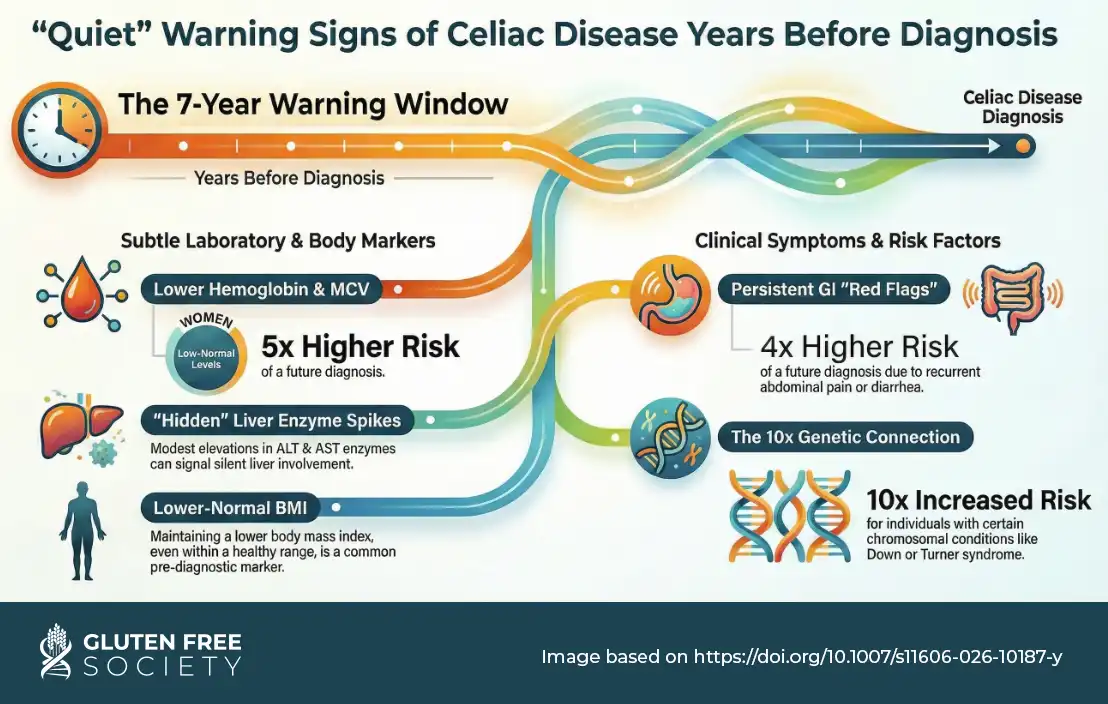
The investigators used a large healthcare database (Clalit Health Services) and looked at over 430,000 adults ages 18–40. They identified early warning signs of people who eventually developed celiac disease based on both:
Then they tracked common labs and clinical features for up to 7 years before diagnosis to see what patterns showed up early before most doctors were even thinking “celiac.”
The most important finding is this:
These weren’t always “abnormal” labs. Many were low-normal or high-normal values that often get shrugged off.
The strongest predictor of future celiac disease was lower hemoglobin (think: anemia risk), especially when paired with lower MCV (meaning smaller red blood cells often an iron deficiency pattern).
Translation: If your blood count is drifting toward anemia – especially iron deficiency pattern, and nobody can explain why… celiac should be on the shortlist.
And here’s the kicker: these trends were visible years before diagnosis in the study’s lab trend graphs (hemoglobin/MCV trends).
Another strong early clue was ALT/AST (liver enzymes). Even when elevations were mild, they were associated with a significantly higher risk of later celiac diagnosis in both sexes.
Translation: If your liver enzymes keep coming back a little high and you don’t drink heavily, don’t have hepatitis, and your doctor says “meh”… that’s not “meh.” That’s a clue.
Untreated celiac can inflame the liver in a quiet way, and many patients never realize gluten could be involved.
People assume celiac means being underweight. Not always.
This study found that a lower BMI (even still “normal”) was linked with increased risk of future celiac diagnosis:
Translation: If you’re the person who “can’t keep weight on” or you’re always on the lean side plus you have low iron patterns or odd labs, you’re not crazy, your gut may not be absorbing well.
You don’t need nonstop diarrhea to have celiac.
Translation: Chronic bloating, abdominal pain, loose stools, “IBS,” or unpredictable digestion should prompt celiac testing.
The highest risk in the model showed up in those with chromosomal abnormalities (the study notes these were largely conditions like Down syndrome and Turner syndrome), with about a 10× higher risk of celiac disease.
Translation: In higher-risk genetic groups, routine celiac screening isn’t optional, it’s smart preventive care.
This is what makes the study so valuable: The lab “breadcrumbs” were detectable as early as 7 years before diagnosis.
And at the time of diagnosis:
That means many people are walking around for years with early, detectable signs while being told their labs are “fine.”
If you or someone you love has any combination of the following:
Common first-line tests typically include tissue transglutaminase antibodies (tTG) and related blood markers, and ideally total IgA so IgA deficiency doesn’t create a false negative scenario (the study itself notes this as a limitation for some cases).
Important: Don’t stop eating gluten before testing, or you can make results falsely negative. Stay on gluten until testing is complete.
This was a retrospective database study, meaning:
Still, the sample size was massive, and the patterns match what clinicians often see: early warnings signs of celiac disease frequently present through anemia patterns, mild liver enzyme changes, and subtle malabsorption signals long before anyone calls it “celiac.”
If your body is dropping hints – i.. low-normal iron labs, “mystery” liver enzymes, IBS symptoms that won’t resolve, and fatigue that doesn’t match your life don’t accept vague reassurance as a diagnosis.

Celiac disease doesn’t always announce itself with a megaphone. Sometimes it just leaves a paper trail in your labs.
And this study shows that trail can start up to 7 years early. If you think gluten may be part of your problem, take the gluten quiz or consider genetic testing through Gluten Free Society to help you determine whether a gluten free diet is right for you.
Silent celiac is celiac disease that does not always show up with the classic digestive symptoms people expect. You may not have severe diarrhea or dramatic stomach pain, but gluten can still be triggering immune damage in the small intestine. In many cases, the earliest clues show up as nutrient deficiency patterns, unexplained fatigue, odd lab work, low body weight, infertility, bone loss, or recurring symptoms that get brushed off as “nothing serious.”
Yes. That is one of the biggest reasons celiac disease is missed for years. Some people have little to no obvious gut distress, while others have symptoms that come and go, such as bloating, abdominal discomfort, constipation, loose stools, or an IBS label that never fully explains the problem. The absence of major digestive symptoms does not rule celiac out.
Early warning signs can include low-normal hemoglobin, low MCV suggesting small red blood cells, mild iron deficiency patterns, slightly elevated ALT or AST, trouble maintaining weight, fatigue, recurrent digestive symptoms, infertility, and other subtle signs of malabsorption. The key point is that these clues may appear years before a formal diagnosis, even when they are not flagged as dramatically abnormal.
Absolutely. One of the most important early clues is an iron-deficiency pattern, especially when there is no obvious cause. If your hemoglobin is drifting down, your red blood cells are getting smaller, or your iron status keeps looking borderline despite supplementation, celiac disease should be on the shortlist. Gluten-driven intestinal damage can impair iron absorption long before the disease is formally diagnosed.
Yes. Mildly elevated liver enzymes can be one of the quiet signs of celiac disease. If ALT or AST keep coming back a little high and there is no clear explanation, gluten-related inflammation and malabsorption deserve consideration. This is one of the patterns that is often dismissed when it should be investigated more carefully.
Yes, and this happens all the time. Chronic bloating, gas, abdominal pain, diarrhea, constipation, or unpredictable digestion are often labeled IBS, but in some people the real issue is celiac disease. If symptoms keep recurring and no one has done a proper celiac workup, that is a gap that needs to be addressed.
It can go undiagnosed for years. The article highlights research showing that subtle clues may appear as early as 7 years before diagnosis. That means many people are being told their labs are “fine” while their body is leaving a very real paper trail.
People with unexplained iron deficiency, chronic digestive issues, infertility concerns, low body weight, family history of celiac disease, or associated genetic and autoimmune conditions are at higher risk. Certain chromosomal conditions, such as Down syndrome and Turner syndrome, also carry a significantly higher risk and warrant more proactive screening.
Common first-line screening usually includes tissue transglutaminase antibodies, often called tTG, along with related antibody markers and a total IgA level to help rule out false negatives in people with IgA deficiency. In some cases, genetic testing can also help clarify whether a gluten-free diet investigation makes sense, especially when the picture is confusing.
Ask your doctor to evaluate you. Especially if you have unexplained anemia patterns, odd liver enzymes, recurring IBS-type symptoms, trouble maintaining weight, infertility concerns, or a family history of celiac disease, ask for proper screening. The earlier you catch it, the better your odds of preventing long-term complications.