new to the gluten free journey?

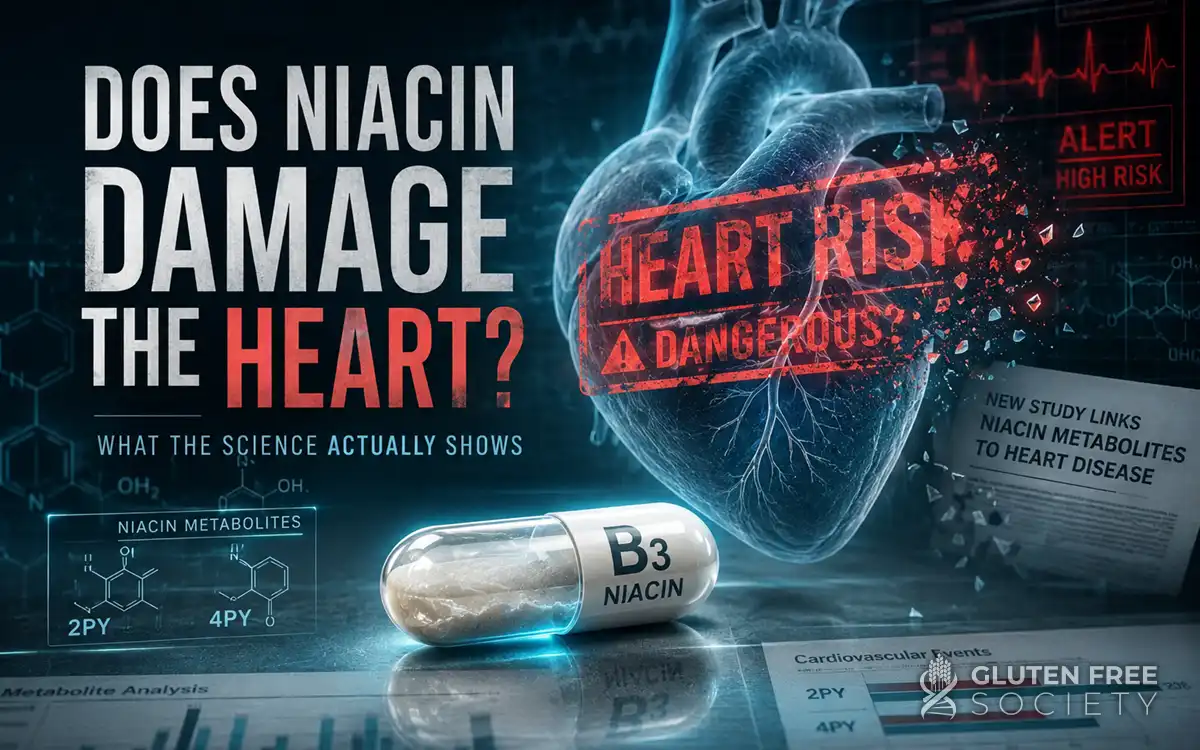
No, current research does not prove that niacin damages the heart. The widely discussed 2024 study only found an association between certain niacin metabolites (2PY and 4PY) and cardiovascular risk. Researchers did not measure how much niacin people consumed or whether niacin itself caused the elevated metabolites. Niacin remains an essential nutrient required for energy production, DNA repair, and healthy metabolism. The real issue may involve altered niacin metabolism, poor clearance, inflammation, kidney dysfunction, fortified processed foods, or other underlying metabolic problems rather than niacin itself. The takeaway: avoid sensational headlines, focus on real food over fortified processed grains, avoid unnecessary high dose supplementation, and use proper testing to evaluate nutrient status instead of guessing.
There is no scientific evidence to make the claim that niacin damages the heart.
The recent claims that niacin increases heart disease risk are extremely misleading. The 2024 Nature Medicine study identified an association between cardiovascular events and niacin metabolites, especially 4PY, but it did not measure how much niacin participants consumed, nor did it establish that niacin intake caused the elevated metabolite levels. This means the study is better interpreted as evidence that altered niacin metabolism may be associated with cardiovascular risk, not proof that niacin itself causes heart disease.
Even Harvard’s summary acknowledged this limitation:
researchers had no information about participants’ dietary niacin intake, and because the study was not a clinical trial, it could not prove niacin was responsible for the observation.
The study, published in Nature Medicine, looked at blood metabolites associated with cardiovascular events. Researchers identified two compounds, 2PY and 4PY, which are terminal breakdown products of niacin metabolism. These metabolites were associated with residual cardiovascular disease risk.
The NIH summary stated that the research team analyzed blood plasma from more than 1,100 people and identified 2PY and 4PY as molecules associated with major adverse cardiac events, such as heart attack and stroke. The researchers later confirmed the association in two additional cohorts totaling more than 3,000 people.
But here is the critical point:
They did not prove that niacin intake caused the problem.
They did not measure:
That distinction matters.
This is where the media often gets nutrition science wrong.
If a study finds that a metabolite is higher in people who have more heart attacks, that does not automatically mean the nutrient that can produce that metabolite is dangerous.
By that logic, we could blame oxygen for oxidative stress, glucose for diabetes, or iron for inflammation. But the body’s metabolism is more complicated than that.
The 2PY and 4PY metabolites can be elevated for multiple reasons:
So when someone says, “Niacin increases heart disease risk,” the correct response is:
Show me where the study measured niacin intake and niacin levels.
In this case, it did not. That study does not exist.
Niacin is not a toxin. It is vitamin B3. Your body requires it to make NAD, one of the most important molecules for cellular energy production, DNA repair, mitochondrial function, and healthy aging.
Severe niacin deficiency causes pellagra, a disease classically associated with dermatitis, diarrhea, dementia, and, if untreated, death. A 2024 population-based study in Scientific Reports noted that niacin is a vital water-soluble nutrient and that deficiency is linked to pellagra.
So the conversation should not be, “Is niacin bad?”
The better question is:
Who needs niacin, what form should they use, how much do they need, and how do we measure whether it is helping or harming?
That is the root-cause approach.
Here is another important piece of the story.
A large NHANES-based study published in Scientific Reports evaluated dietary niacin intake in 26,746 U.S. adults with a median follow-up of 9.17 years. The study found that people in the highest quartile of dietary niacin intake had a lower risk of all-cause mortality and a lower risk of cardiovascular mortality compared with those in the lowest quartile.
Specifically, the highest dietary niacin intake group had:
| Outcome | Hazard Ratio in Highest Niacin Intake Group |
|---|---|
| All-cause mortality | 0.74 |
| Cardiovascular mortality | 0.73 |
In plain English, higher dietary niacin intake was associated with lower death risk, including lower cardiovascular death risk, in that population.
Now, this study also has limitations. Dietary intake was self-reported, and observational research cannot prove causation. But it directly measured dietary niacin intake, while the niacin-metabolite study did not.
So we should be careful before telling the public that niacin causes heart disease.
There is a difference between:
Those are not the same thing.
High-dose niacin, often in the range of 1,500 to 2,000 mg per day, has been used historically as a lipid-lowering drug. NIH notes that high-dose niacin was one of the first cholesterol-lowering drugs, but studies on heart attack and stroke outcomes have produced mixed results.
So let’s be clear:
I am not recommending that everyone take high-dose niacin.
But I am saying that the recent metabolite study does not prove that niacin causes heart disease.
One of the more interesting parts of this discussion is food fortification.
Niacin is added to enriched grain products in the United States. NIH notes that enriched foods in the U.S. must contain added niacin, and many staple foods like cereals, flour, oats, and grains are fortified in many countries to prevent deficiency.
This raises a better public health question:
Are people being overexposed to synthetic B vitamins because of processed, fortified grain-based foods?
That is a very different question than, “Is niacin dangerous?”
From a functional medicine perspective, I would rather see people get nutrients from real food first: meat, poultry, fish, eggs, nuts, seeds, and properly selected whole foods that do not trigger immune reactions.
For gluten-sensitive patients, enriched wheat flour is not a health food just because it contains added B vitamins. Fortifying a problematic food does not make it biologically appropriate for everyone.
The real answer is not fear. The real answer is measurement.
Before declaring niacin dangerous or beneficial, we should ask:
This is why I often say: test, don’t guess.
A functional assessment of nutrient status, including intracellular nutrient analysis when appropriate, gives us a better picture than headlines based on metabolite associations.
Niacin is an essential vitamin. The recent study does not prove that niacin intake causes heart disease because researchers did not measure niacin intake or niacin blood levels in the participants. They measured niacin metabolites, mainly 2PY and 4PY, and found only an association with cardiovascular risk – not a cause.
That finding deserves more research, but it should not be twisted into the claim that niacin is bad for the heart.
A more accurate conclusion is:
Elevated niacin breakdown products may be a marker of altered metabolism, excess exposure, impaired clearance, or disease risk, but the study does not prove that niacin intake causes heart disease.
For most people, the safest strategy is simple:
Eat real food. Avoid fortified processed grain products. Do not take high-dose niacin unless there is a clear clinical reason and proper supervision. Measure nutrient status when possible. And never let a headline replace critical thinking.
No. The recent study does not prove that niacin increases heart disease risk. It found that higher blood levels of niacin breakdown products, 2PY and 4PY, were associated with higher cardiovascular risk. The study did not measure niacin intake or niacin levels in the patients.
No. There is currently no scientific evidence that demonstrates that niacin is cardiotoxin (toxic to the heart).
No. Harvard’s summary specifically notes that researchers had no information about participants’ dietary niacin intake.
The study focused on niacin metabolites, especially 2PY and 4PY, not on proving that measured niacin intake or measured niacin status caused cardiovascular events.
High-dose niacin should not be used casually. It can cause flushing, liver stress, blood sugar changes, gastrointestinal symptoms, and other adverse effects. Harvard notes that high-dose niacin has been associated with increased diabetes risk and serious gastrointestinal side effects.
Current evidence does not show that normal dietary niacin is harmful. In a large NHANES-based study, higher dietary niacin intake was associated with lower all-cause and cardiovascular mortality.
Do not make that decision from a headline. The right answer depends on your dose, form, diet, medical history, medications, blood sugar status, liver health, kidney function, and nutrient testing. For high-dose niacin, work with a qualified clinician.