
Research Review Shows That Gluten Causes Leaky Gut
The primary functions of the gastrointestinal tract have traditionally been perceived to be limited to the digestion and absorption of nutrients and to electrolytes and water homeostasis. A more attentive analysis of the anatomic and functional arrangement of the gastrointestinal tract, however, suggests that another extremely important function of this organ is its ability to regulate the trafficking of macromolecules between the environment and the host through a barrier mechanism. Together with the gut-associated lymphoid tissue and the neuroendocrine network, the intestinal epithelial barrier, with its intercellular tight junctions, controls the equilibrium between tolerance and immunity to non-self antigens. Zonulin is the only physiological modulator of intercellular tight junctions described so far that is involved in trafficking of macromolecules and, therefore, in tolerance/immune response balance. When the finely tuned zonulin pathway is deregulated in genetically susceptible individuals, both intestinal and extraintestinal autoimmune, inflammatory, and neoplastic disorders can occur. This new paradigm subverts traditional theories underlying the development of these diseases and suggests that these processes can be arrested if the interplay between genes and environmental triggers is prevented by reestablishing the zonulin-dependent intestinal barrier function.
Research Source:
Physiol Rev. 2011 Jan;91(1):151-75.
Leaky Gut in Layman’s Terms
I was recently interviewed by Leaky Gut expert, Karen Brimeyer. We discussed the ins and outs of this intestinal affliction in an easy to understand manner. You can watch the interview below:
Karen specializes in helping people recover from leaky gut syndrome. You can learn more about her Leaky Gut Cure Program here <<<
You can also read more on supplements to help correct the problem here <<<
Dr. Fasano Discovered Leaky Gut
Multiple research studies have linked gluten to the condition known as intestinal permeability – I recently had the privilege of speaking with one of the leading gluten sensitivity researchers in the world, Dr. Alessio Fasano. He is the head of research at the University of Maryland Celiac Research Center, and he is responsible for discovering the gluten/leaky gut connection. In this video, we discuss how this condition can affect the gut, the brain, and multiple other tissues in the body…
Making the Connection – The Gluten Free Warrior’s Stance:
Most people assume that celiac disease and gluten sensitivity are the same thing. Fortunately, this archaic thought is rapidly changing as new research has proven that gluten sensitivity exists independently of celiac disease. Although it is well established that gluten often impacts the villi of the small intestine, it has also been shown to affect the body in multiple ways. These differences account for the massive failure of doctors to diagnose gluten sensitivity. Below is a diagram of environmental triggers to intestinal permeability (leaky gut). You will find that gluten sensitivity can directly and indirectly contribute to this problem. To the intelligent observer, this picture illustrates why simple antibody testing fails to accurately diagnosis gluten sensitivity. Antibody production is only one lab component of a multi-faceted problem.
Click on image to enlarge…
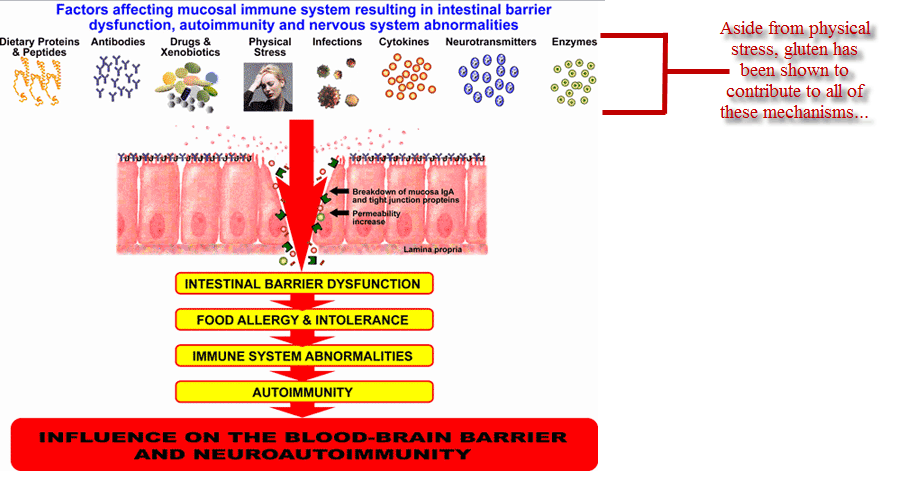
How Does Gluten Play a Role in All of These Factors?
- Gluten – As stated above, gluten directly impacts the intestinal lining through zonulin production. Zonulin is a protein that directly causes leaky gut.
- Antibodies – Gluten contributes to the formation antibodies. Antibodies can cause the secretion of inflammatory chemicals leading to tissue damage. Additionally, through a process called molecular mimicry, antibodies can cross react with the tissues of the body causing autoimmune disease. Lab tests measuring these antibodies are typically not associated with gluten because most doctors are not trained adequately to identify the connection.
- Medications – Many medications commonly contain gluten leading to a direct effect. However, many chronic health conditions caused by gluten sensitivity are misdiagnosed leading to medicine prescriptions that are not only unnecessary, but can be detrimental to the gastrointestinal tract. Anti-acid medications are a common example. These medications predispose to infection and lead to abnormal bacteria presence in the gut. Over utilization of antibiotics to treat viral infection is another example.
- Stress – Although not a physical stressor, gluten is a chemical stressor on the body. Chemical stress comes in many forms. One of them is vitamin and mineral deficiency. Loss of key nutrients causes a fundamental breakdown in the body’s ability to modulate the healing and repair process.
- Bacteria – Gluten ingestion causes detrimental changes in intestinal flora (AKA gut dysbiosis) predisposing to infection. This is one of the reasons why so many yogurt companies are adding beneficial bacteria to their products. Gut dysbiosis is an epidemic in the U.S. If you need a gluten free probiotic go here <<<
- Cytokines – Gluten induces the production of pro-inflammatory cytokines (chemicals that damage cells).
- Neurotransmitters – Gluten causes neurochemical changes in the production of neurotransmitters (chemicals that allow the nervous system to communicate). Examples include: serotonin, dopamine, acetylcholine, epinephrine, and histamine. Gluten is also a neurotoxin that has been shown to damage nerve tissue. This is the reason so many with neurological disease (autism, migraine headaches, ADD, bipolar, schizophrenia, neuropathy, epilepsy, etc.) do well on a gluten free diet.
- Digestive chemicals – Gluten can damage the intestine, the pancreas, the liver, and the gall bladder. All of these organs play a pivotal role in the body’s ability to produce digestive chemicals and enzymes. When this mechanism is compromised, digestive processes start to break down and become ineffective.
Sum it all up –
Leaky gut contributes to autoimmune disease. The only known cause for any autoimmune disease is gluten sensitivity. We are blind fools to ignore this connection because it does not fit the status quo of the allopathic medical paradigm. If you have autoimmune disease and have not investigated gluten sensitivity as a contributing factor, you should. Learn more about genetic testing for gluten sensitivity now!






24 Responses
Thank you! I think this is me! I am in stage three kidney disease. I have gotten a rash with allapurinol, stumbled into Celiac info and have started gluten free diet. After only several days I can’t believe how much better I feel! I think I may have found my answer and am so optimistic. I want to be healthy again, not just medicated. Thank you for your article!
The sound quality was bad…but I listened to the whole thing the best I could. When I read the list of gluten symptoms in kids, I had several my whole life, until I went gluten free. And when I went gluten free it wasn’t even for these reasons. They were just a happy byproduct of getting the junk out of my diet. I have no desire to be tested. I’m sure I’m Celiac. A naturopath diagnosed me because of some health issues that cleared up after being gluten free. She saw no reason to put me on gluten to be tested. I don’t need an official diagnoses, I have no desire to feel bad again. I have a daughter that has had eczema her whole life. Finally at 15 she tried gluten free. Her transformation has been nothing short of miraculous! She is a new person. We eat good whole foods that I cook at home. It’s too bad it took us so long to figure this out. All the wasted time of feeling awful. It’s not that hard to go gluten free once you get your mind wrapped around it and it is so worth it!!!!!
Thank You! My daughter and I are doing much better now that we are gluten free. My husband is still suffering.
Gluten and alcohol free is a must for leaky gut. Autoimmune paleo diet (additionally free of eggs, milk, nightshades) is good way to improve further.
I have been gf for 8 years now. I still have many other food sensitivities that I believe are a cause of my auto immune deficiency. Of course allopathic medicine is a joke with my case.
My question is, I have horrible gas and air inside when I eat. My stomach burns without my antacid medication. Am I hurting the lining of my stomach taking this? What would I do to replace it? I’m a pretty severe case. I almost died 8 years ago.
Thank you
Loosen.
Koleen, You need to find and work with a functional medicine doctor. This situation is too complex to answer in this forum. You can call 281-240-2229 if you would like to consult with Dr. Osborne.
Hi,
I saw your video on youtube and was impressed, as I have many of the health issues you mentioned.
When you say to stop eating grains–what exactly do you mean by that?
I’m finding it hard to pin down a definition of grain; and grass; and since you are the one recommending that, your definition–for these purposes–is what I’m after.
I’ve been finding even amongst “experts”, scientists, etc. some calling a plant a grain and others saying it isn’t–without clarifying the meaning.
Same for grasses.
thank you
P.
Technically speaking, grains are the seeds of grass. There are many different species of grass. The most common are wheat, barley, rye, oat, sorghum, millet, corn, and rice. There are some foods that commonly get confused with grain – buckwheat, amaranth, and quinoa. These are technically not grains, but because they are commonly cross contaminated with grain and because some research shows them to cause inflammatory reactions in patients with gluten sensitivity, I recommend avoidance.
Hope that clarifies.
All the best,
Dr. O
When I knew for sure that I was gluten intolerant, I wanted to know if there were other foods that I should not eat, so I had the Array four test done by Cyrex. I discovered that I needed to avoid all dairy, eggs, nightshade plants like tomatoes and potatoes, and others. I wanted to know what was in common with these foods and discovered that they have lectins, some that cause symptoms similar to wheat; even watermelon. So now I avoid all foods with the lectins that can cause adverse effects and no longer have GERD, constipation, foggy thinking, bloating and through therapy by Dr. Corey King, have regained my balance and a lot of the memory that I had lost. Functional medicine saved me from a miserable life. I hope it will save many others.
I suffer from systemic yeast which started after I took accutane about 10 years ago. I have had several ALCATs done and, at first, I had NO gluten sensitivies, but then years later it said I had a mild sensitivity. I am not a big meat eater and will never be. I am very underweight (110 lbs at 5’8″)because of my candida-safe diet. I do not understand what I can eat. Fruit supposedly feeds the yeast so I stay away from that. I eat A LOT of greens (kale, spinach, okra, cabbage, avacados etc. . . ). I started reintroducing brown and wild rice because my weight was going down so much from just eating greens. I feel like I am wasting away and I do not know what to do!
Check out Dr Jennifer Daniels Candida killer. It’s based on turpentine which is pine essential oil. I did this protocol and it saved me and my kids life of so much suffering. Years and years of suffering ended in 5 days and no bad side effects at all. I am a huge promoter of turpentine it kills Candida the fastest! I never knew Candida and gluten could cause so much damage untill the damage was done. I know do no grains and no potatoes and feel like a new person. I am thin but that’s ok because when I eat grains and sugar I blow up really fast and that never feels good. Oh and the things that came out of my familes rear ends was nothing short of grosss!! Parasites are fur real and make us really sick. You can eat fruit on this diet just no meat. I eat fruit all day and it does not make Candida form. It cleans my tongue of all the Candida with first dose and my tongue is finally pink and not white:) it’s gangster! Sending unicorn hugs and have a blessed day!
Thank you for your comment. I have struggled with the systemic yeast overgrown for years as well as celiac disease. I know I have parasites as well due to a recent dry blood test. I also have heavy metals, aluminum and mercury in my body. I am fascinated with your turpentine cure. If you could give me more information I would really appreciate it.
Check out “Zeolite” for heavy metal detox. You will feel improvements imediately 😉
Dr. O, I am gluten sensitive with Hashi. I have an ex with adhd and 2 teenage sons suffering with allergies, adhd, anxiety, depression. With the combo of genes between mom and dad here which specific testing can you recommend be done for both boys? We are on max meds and I do not have dietary compliance with oldest who is almost 18. He is going to college soon and his executive functioning is severely impaired. He also has a deviated septum which I believe is affecting oxygen to brain during sleep. I am desperate to get help! HELP!
I recommend finding some educational video content for your eledest son. Gotta lead a horse to water, can’t just tell it where to find it. Also Zeolite, for combating 21st century exposure to environmental toxins, it seems they contribute to just about every condition under the son. P.s. turn the wifi router off before bed 😉
my Husband has celiac. He found out and was tested back in 2002, and he has a lot of other problems. he had back surgery L3, L4 L5 and S1 he has rods and cages.
he just had neck surgery for his disk and nerve trouble. I have told him to get off all grain but he says if it says it is gluten free than he can eat it. my question is how can the government let this happen that the food co. can say a product is gluten free when it is not??? He has all kinds of health problems and I need to get him fixed but he thinks I am not to be listen to. I have been with this man for 48+ years and want to keep him around for a few more years, When he was in the hospital we told them he was on a gluten free diet and they sent his 1st try up with a Brownie, that is a Hospital u would think they know how to cook for a gluten free person….
Leaky Gut was discovered in 1908 in western Europe. Dr. Fasano doesn’t look old enough to have been alive at that time.
Becky,
Forgive me. Dr. Fasano discovered the protein (zonulin) responsible for maintaining the barrier in the GI tract.
Have a great weekend!
All the best,
Dr. Osborne – The Gluten Free Warrior
I’ve been allergy tested and need to avoid gliaden, gluten etc., however, when I eat organic whole wheat I do not have any digestive reactions. Does this mean I am not gluten sensitive? Is organic wheat healthy to eat? Surely even organic wheat has gluten, right? So, what is the difference between organic and non-organic wheat? Thx
Only in last week, I’ve found Dr Osborne – thank you so much! – your work is superb. I’m 61, live in SA. On 26.2.2016 (58), went to sleep as normal self, woke next morning immediately feeling something seriously wrong in my brain from behind my R-ear across my forehead at the hairline, was staggering holding onto walls/cupboards, slurred speech, vision problems, deafening noise in my head, no coordination in my hands, kind of paralysis in my legs, nystagmus – worsened in 3 days, now included my cerebellum, constant ‘brain attacks’, literally felt something attacking my brain, in severe brain attacks I couldn’t stay upright had to lie down, also passing terrible unusual gas, but didn’t make the connection that my brain & the gas/stomach were ‘linked’ in this problem.Daughter came to help, had to walk with crutches, felt like I would die if I didn’t get help. My Dr/GP put me in hospital, 2nd dr/specialist said virus, 3rd dr/neurologist did full virus tests, spinal tap, brain MRI = nothing showed except Vit B12 was 139 – put on Lyrica, Prednisone, B12 injections/supplements, said a virus. Reacted badly to prednisone, but not listened to. Woke 2 weeks later knowing I needed hospital, husband took me – BP was 195/115, put into ICU overnight, Predisone reduced, luckily no kidney damage. Was afraid of the Lyrica so increased my bread intake, ate 2 extra slices wholewheat/brown bread 2xp/day! Continued with neurologist, after 17 months still no diagnosis, referred me to colleague – I said ‘no’, continued with own extensive internet research, also weaned self slowly off Lyrica. One day I read the words: nerve in the gut directly linked to the brain… knew I was onto something… went back to my GP, he diagnosed ataxia, still with crutches, brain attacks etc. getting worse. Went to ear specialist, immediately said something wrong in my cerebellum. Had hearing test = lost high frequency hearing; dentist picked up Zinc deficiency as sore in my mouth wouldn’t heal, 10 days on zinc supplement & sore healed, then I went to scio therapist, her reading immediately picked up brain problem, also said sensitive to gluten & wheat & that my stomach is ‘smooth’… hours more research, still looking for this gut/brain axis-connection… found ataxia which said one of the ataxias responds well to gluten free diet… I was desperate, didn’t know how to live like that anymore, how long could I still drive, how long before the wheelchair was part of my life… then I found Celiac on Google, wondered if that was part of it & decided I had nothing to lose trying gluten free so started GF on 22.8.2018… at the end of week 3, I could say that from the beginning of week 3 I had not had one single brain attack! It was like a miracle from Heaven, I have no words, am so grateful… could walk normally, had balance, coordination etc. Then in further research under Celiac, came across Gluten Ataxia = finally there was the answer! Made 3 mistakes = 1st was cross-reaction to prescribed antibiotic, 2nd mistakenly glutened because couldn’t read the small print on the label, 3rd was cross-contamination. Am 6 months GF now, it has completely changed my life. Looked back & understand now my ongoing stomach/bowel issues, depression, anxiety etc., certain I have Celiac/recent weight loss, not absorbing nutrients, working now on fixing my gut. Still a little something not right with my brain, maybe it will heal in time. I would never have quit looking for the answer… best wishes to you all on your GF healing journey, & to Dr Osborne, may you be blessed for all the good & valuable work you’ve done & do to help so many others with their health, including myself – what you do is VITAL. This is the short version of my wonky-brain story! With love & gratitude, Lindsay
Thank you Lindsay!
My autistic son was diagnosed at age 2 and had a colonoscopy at age 6. From the brief description of your book: Parents could read this and attempt to treat their own children. You are breaking the law by TELLing people to try and cure their own disease without a qualified physician. There are many physicians, and they are not all expensive and some will give a break to many. This is how Dr. Jeff Bradstreet applied his knowledge. He was killed for trying to identify one thing that was being ignored. He did believe that vaccines are good, he believed in “clean” vaccines and in 2001 the Pharmacies finally did exactly what he had suggested, (not certain of Merck, I knew a few Chem Engr who worked there) They took thimerosal out of HepB. However it is still in flu shots and, I am not sure where else. You can only know if you ask, very specifically, for these ingredients, by name. The adjuvant, aluminum has been found to cause allergies to food, and it’s presence in the bloodstream, in a heavy metal blood test, will hide the presence of other metals, until after, it has been SAFELY and appropriately reduced. And, please, WTF is Zonulin. I have been following this subject for 20 years (my son is 22) and my husband and I finished graduate degrees in Engineering (I minored in Material Science doing semiconductor research) and we also worked with Dr. Rossignol and Scott Smith PA with Central Florida Functional Medicine {who Eric still sees). Please contact Scott at staff@centralfloridafunctionalmedicine.org to tell him how to cure leaky gut, as he deals with this. My son had thimerosal at 1 or 2 weeks after he was prematurely born 10 weeks, and weighed 3.5lbs. He lived in NICU for many weeks, and we trusted hospitals and GP back in those days, for only 6 years prior, I had lived in a hospital for 3 months due to a TBI in a car crash, caused by a sleepy driver, who hit the rear driver side, where I was sitting. I was a UVa EE grad student. My recovery went very well. My husband, my son and I are gluten free and now mostly vegan. Please, how do you know, without a shadow of a doubt, that GF sensitivity is unrelated to environmental toxins, such as vaccine adjuvants, GM which gives rise to significantly more ingestion of Monsanto products, and has nothing to do with the increase in the number of vaccines, with “added toxic” ingredients? Have you seen the theoretical graphs of chronic disease per capita vs #vaccines or GM products, the amount of pesticides consumed… The increase in anxiety. I’m 54, and successfully lived through hell, and have been happily married over 25 years. It is simple to accurately testify to the increase in nonsensical abuse of humans by other humans, esp. with the study of Buddhism. Was born and bred UU, it needs a good leader.
Good luck,
Money will never, ever make you happier after you can feed and clothe yourself.
https://en.wikipedia.org/wiki/Wikipedia:WikiProject_Skepticism/List_of_questionable_claims
Lisa